Showing posts with label textile tuesday. Show all posts

Monday, August 15, 2011

Textile Tuesdays : #30 Something I found at the Art Gallery of NSW


I had a friend visiting from The States, so I took him to my favorite art gallery here in Sydney - The Art Gallery of New South Wales. One whole wing of 20th century art was closed off for an exhibit change, so we spent more time than usual in the Asian art section. We found a stairway that led to an upstairs wing I had never seen. It was full of beautiful sculptures of Buddhas and I found these gorgeous Indonesian batik clothes. They were not that old - only from the early 1900s, but they were dyed with natural dyes and the patterns and colors were exquisite.

Tuesday, August 31, 2010

Textile Tuesdays : #29 - Buttons!


This humble item goes unnoticed and taken for granted by some designers and consumers. But there was a moment in history (around the middle of the 13th century) when someone thought "I have an idea!" and they designed the button as we know it. Actually, buttons have been around since the Bronze age, but they were strictly decorative. The big idea was actually, the buttonhole! Before that, people used ties, toggles, and pins to fix and fasten clothing. They became mass produced during the industrial revolution and the rest is history...

Buttons can be made of many wonderful, or not so wonderful, materials - everything from diamonds to plastic, fabric to coconut shells. They can blend with the garment or stand out. Whatever the desired look, the quality of the garment and the skill of the designer can be revealed in the buttons chosen.

Anyone interested in buttons can find whole books written on the subject (on Amazon).

The photos at the top are all from etsy sellers.
Pine buttons from Woods of Narnia
Glass buttons from Treasure Booth
Clay buttons from Ruth Robinson Ceramics

Tuesday, June 29, 2010

Textile Tuesdays : #28 - Textile Circus


In a random and playful mood, I decided to do a stream of consciousness post. I did a search on Etsy of the word "textile" and then the first thing that came into my mind which was "circus". There were thousands of items with the tag of textile but only 24 with both words. I did a little searching of the stores that came up to find what I like and here is I what came up with:

Kawaii elephant fabric from Emicraft, a mod-looking embroidered cuff by Waterrose, and a super stylish and cool collar necklace from Calliekins!

I know there are a ton more circus inspired textile items out there but they weren't tagged with the right combination of words!! Maybe I'll look around and come up with a more extensive list and post next week. It is fun to be spontaneous though. You never know what favorite thing you might find. (I really like that collar!!)

Tuesday, June 22, 2010

Textile Tuesdays : #27 - The Textile Museum


I want to highlight museums focused on textiles. There are so many great ones and they rarely get a mention in tour books or on the "must see" lists. This is a burn to myself and anyone who love the vast and amazing history of textiles. So here is the first of my list of places to check out if you are in the host cities.

The Textile Museum in Washington D.C.

Tuesday, June 15, 2010

Textile Tuesdays : #26 - Linen


With Summer pretty much here it is a good time to talk about one of the stars of textiles - Linen.
The look of linen is always distinct and classic. It speaks of warm weather, raw, basic goodness, integrity, and the natural world. It can be very chic and aristocratic, or rough and wild when fashioned by hippies or SCA members making peasant costumes. Either way, the slouchy wrinkled texture is part of the charm of linen.

Linen is one of the oldest fabrics known to humans. Pieces of it have been found in caves around Europe that are tens of thousands of years old and mummies in Egyptian tombs were wrapped in it. It is also one of the strongest of the vegetable fibers - two to three times stronger than cotton. Because it is highly absorbent it is great for warm temperatures. This is also why it is famous in the kitchen as a towel, napkin, or table cloth. In fact the word "linen" is synonymous with all cloths used in the home as in "the linen closet".

Linen is actually a fabric derived from the Flax plant, a delicate looking wildflower with a small blue blossom. It is a hearty perennial that grows just about anywhere but is primarily grown for fiber production in Europe and China. The most famous linen comes from Ireland, Italy, and Belgium. The flax plant (like hemp) is very useful to humans giving not only fiber for fabric but also highly nutritious seeds and linseed oil. (Did you know that the original Linoleum was made of flax bi-products?)

There is a post with lots of facts and trivia on Wikipedia and here in How Products are Made.
Read up if you want to be a textile nerd like me!


Tuesday, June 1, 2010

Textile Tuesdays : #25 FOUND in Sydney


When I was in Sydney, Australia last week, I walked all over the city. Day after day I trekked to and from my hotel, starting and returning to the same streets. One day, I told my husband we should cut down a small alley just for the diversion. It looked like an empty alleyway, just wide enough for pedestrians, with no doors, windows, or signs.

However, once in the narrow space, we discovered that there were display cases on the wall holding amazing works of art! It was like a secret surprise! Best of all, two of the cases had fiber arts!

The two works in the photos above have small bud or basket-like shapes crocheted out of plastic bags and plastic close tabs, bits of paper and string. The first one is arranged with old plastic knitting needles to look like a vase of flowers. The second one, with wood, lace and concrete, looks like a landscape, or something architectural.

There were no signatures or descriptions anywhere that I could see so the makers and the purpose is a mystery - one that absolutely made my day!

Tuesday, May 25, 2010

Textile Tuesdays : #24 - Hampton Court, Part 3


The rain continued to fall off and on all day. We tried to explore the gardens and the grounds whenever there was a break. There was a vast open garden with sculpted trees, shrubs. There were geometric paths cutting through the grass, converging on a big fountain, which was still spraying water despite the rain. A majestic swan floated peacefully around the fountain. I can still hear our footsteps padding through the soaked gravel in the silence. Mira approached the swan calmly and fearlessly, kneeling down to commune with it. She squatted there for a long time with neither one of them moving. The swan faced her but did not come toward or away from her. As other tourists came out, they took photographs of this enchanted scene. We had to move on though because there was also a sunken garden, a giant grapevine, a long wisteria arbor, and a boxwood maze to get through. Even in the rain, we could not help but stop and smell the lilacs dripping off the bushes all around us.

Towards the end of the day, as we were getting tired and thinking about the train ride back, we decided that we just had time to go look at the Tudor kitchens. These are several large rooms with huge fire pits, large stone tables and racks with dead birds and rabbits hanging by their feet. The kitchens have been kept in tact as an educational exhibit and there is a model with a taped recording describing the way they were run.

On our way out, we walked down an out of the way corridor, and I happen to notice a closed door with a sign that read “Embroiderer’s Guild”. This sign seemed totally out of place to me. There were no other offices or shops near where we were and the only ones we had seen at all were connected to the running of the palace. I felt a bit like Alice when she comes upon the bottle that says, “Drink Me”. I remembered the guild’s booth from the needlecraft show but I had no idea that they could be found at Hampton Court.

I didn’t know if it was open to the public, but I decided that I had to check it out. Inside was a small room with hallways leading to a few back rooms. These back rooms were for members to do work, have tea and lead classes in needlework. The front area had a small counter and two walls lined with books – hundreds of books on all subject having to do with textiles! They were piled up on the floor as well. There were books on textiles from different regions such as Turkish rugs or Thai embroidery. There were whole sections on histories from quilting to fabric production. There were shelves of books on technique. They had fabric printing and dying, embroidery stitches, knitting, weaving, quilting – everything you could think of and more. They even had a section of children’s books having to do with fiber arts.

I kept sighing “oh my God”, over and over. I was overwhelmed and caught completely off guard at the end of the day, in a castle, in England, in a fiber artists dream. I forced myself to focus and grabbed a few things: one on quilting, one on embroidery and watercolor, one on textiles and one on doll making. I thumbed through them quickly and they all looked great. I couldn’t afford to buy a whole stack but I decided to let myself get one.

The Anatomy of a Doll by Suzanne Oroyan caught my eye. I was so excited to see an artistic treatment of the subject, one that was completely in line with my own style of thinking and similar to my work. It contained the original creations of almost one hundred different doll makers. Besides pages of beautiful photos and an introduction designed to inspire creativity, it also had specific instructions on how to achieve certain effects in facial expression, body type etc.

While I had planned to get something on textile production or embroidery, I could not pass this one up, so I bought it. I was so inspired by the designs but also by the mere fact that so many women (mostly) were dedicating their time and creativity to something that a large percentage of the population would consider frivolous but which I loved. These designers were treating dolls as art and the results were wild, gorgeous and inspired. I wondered who these women were and where they lived. I guessed that they must be English and that the book was a British publication since that was the context in which I had found it. Imagine my surprise when I saw that it was an American publisher and that the author lived in Eugene, Oregon which is where I had lived when I was selling my own dolls at galleries and craft shows. The whole coincidence and the circumstances under which I had come to the book made me feel like fate, serendipity or something (maybe a ghost) was at work that day.

Before we left, I got a book list from the Guild for future reference. Mira turned in her ghost sighting worksheet to the information desk and got her picture taken with the two gentlemen who seemed as enchanted by her as we were with the palace. As we rode home on the train we saw two unmistakably bright green parrots fly by the window in the rain. We got into a discussion with two American tourists who were over on their annual bird watching holiday. What started out as a miserable stormy day had turned into a dream. We had seen history preserved, had smelt flowers thriving in a storm, spent really good mother/daughter time, and had discovered a great fiber arts resource. I mulled over all of it in my mind and I sleepily thought how much I liked London and all it had to offer.

(I finally found some of the pictures from out day at Hampton Court and scanned them into my iphoto. The resolution isn't so great but at least you can get a feel for the day. Notice, I am wearing a skirt!)

Tuesday, May 11, 2010

Textile Tuesdays : #23 - Hampton Court, Part 2


The continuing day of adventure in an English castle that led to a textile discovery...

Even though we were anxious to tour around the grounds, we were hungry and wanted to get warmed and revitalized. The woman who gave us our tickets pointed the way to a garden café. Walking through the dripping shrubs and trees, on our way to the tearoom, we saw a large group of completely soaked teen-agers rushing in the opposite direction. They were French students escaping back into their bus. Hopefully, they were able to glean some enrichment from their field trip.

The café was warm and cozy with lovely soups, tea, breads and other perfect lunch items. The walls were full of windows that gave a nice view of the surrounding gardens. We could hear the wind squeaking through the cracks and see it whipping the branches back and forth. After soup, sandwich and some yogurt, I indulged my daughter with hot chocolate and a donut and I sipped hot milky tea. Mira kept smiling at me and telling me that I was the best mommy in the world. At that moment, I felt like I was definitely a contender. Sometimes it’s easy to be a good mother. I wanted to hold that moment and never let it end. Part of me said it was time to move on so we could see what there was to see.

Inside we went to the information center first to get some activity materials that they have especially for children. Out of three or four different activities, Mira chose one that involved exploring possible ghost sightings. We had a great time investigating the various locations where people had reported stories of ghosts over the years. This got us moving around the castle and gave us some background on various historic people and incidents. Since the storm was blowing the windows and things seemed dark and empty, it was not hard to imagine that there might be some truth to the stories. At one point we heard a loud high voice rising up through the halls. Everyone, including the guards, stopped and stared, then another guard walked by and said that the soprano from the opera was going to be performing at a special dinner there and she was practicing.

Wandering around, I kept my eyes open for textile sightings as well. In several of the rooms, there were 15th century Belgian tapestries that hung from the ceiling to the floor, just where they have been hanging for about the past four hundred years. They were originally hung as decoration but also to keep the rooms warmer and sometimes to conceal secret doorways. It is unbelievable that they are still in such good condition.

Other textiles that I noticed were the beddings. Silk covered the quilts, pillows and canopies as well as the actual posts and bed frames. These, I found out, had not survived in their original condition, but were restored. In one room, the entire bed was covered in burgundy silk brocade and in another room it was gold. The whole effect was very rich but plain which was typical of much of the English style at that time.

In the chapel, there were kneelers that had been needlepoint stitched with various royal insignia or images of Hampton Court Palace. There was a thistle, which stands for the Stuart family and the Tudor rose. There was also the image of four pillars, each with a different pattern on it. I had seen this image and actual pillars like it around London but I did not know what it represented. It is common to see stitched kneeling pillows in chapels and churches around England. These are done by the local churchwomen and donated to the church. This ancient tradition carried over to modern life, is just another example of the status and prominence of needlework in English society.

(The final part next tuesday..)

(I can't believe that after searching through hundreds of images on the web, I can't find any of the needlepoint kneelers at Hampton Court. I have seen such a variety of needlepoint images -good and bad - that I am going to have to do another post just on that. Unfortunately, when I was there, it was before digital cameras and my photos are packed away. I will try to dig them out! so the photos at the top are the closest I could get.)

1. An embroidery done by Mary Queen of Scots

2. An authentic reproduction of a Tudor bed with embroidered fabric made by Stuart Interiors.

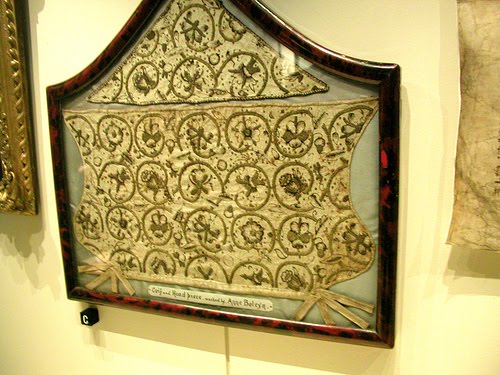
3. A screen embroidered by Anne Boleyn

4. Needlepoint Kneelers from a different church in England (sorry I don't know which)

Tuesday, May 4, 2010

Textile Tuesdays : #23 - Hampton Court England - Part 1


The photos above are from a blog called Tier 1London. Unfortunately, when we were there it was before digital, so all my beautiful photos are buried somewhere in storage.

Here is part one of my story that really does have something to do with textiles in the end! but you will have to check in for part 2....

By the middle of May the weather was still off and on with rain and sunshine. Some days were wet and stormy and others held the promise of summer and heat. After being forced out of our flat so the landlady’s son could move in and live rent free, we had moved into a quaint but small Victorian conversion flat. It was on a nice street that was mercifully closer to the girls’ school but it was actually smaller and darker than our old cube-shaped apartment. We were only going to be there for two months before we heading out to Ireland and then home, so we didn’t even unpack all of our boxes. It hardly seemed worth the trouble but it did make the apartment seem unsettled. The space was cramped and torturous acoustically due to high ceilings, thin walls and wooden floors. Because of this we could hear all the noises the neighbors made, our own voices floated and bounced around the rooms, and worst of all, the girls had to refrain from shouting and jumping around. Unfortunately, this is exactly what they felt like doing after being cooped up for so many rainy months.

The winter had been long and difficult and the unwelcome move had left us all a little more fragile. My older daughter, Mira, who was normally quiet and sweet, had been crying and whining a lot. She wanted to be with me all the time and did not want to go to school. I was a little worried because after their initial settling in, both girls had loved their school. The teachers, students and administrators at Highgate Primary had provided friendship, encouragement and a sense of belonging. At this point however, the instability of our living situation compounded by the fact that her beloved teacher had taken ill and been replaced by a substitute, had made Mira shy and unhappy.

I decided that I would take her out of school one day, and the two of us would go on a relaxing and rejuvenating outing to Hampton Court. David agreed to stay home from the office and watch Valerie so Mira and I could have one on one time. We planned to go on a Thursday to avoid the weekend crowds. Unfortunately (and typically) it happened on that day to be pouring and gusting wildly. The girls were crying and David and I were arguing about what to do. We had had our hearts set on it, the girls had missed the start of the school day, and I had the travel logistics all planned out. Staying in the gray, little flat was too grim an option so we decided to charge on. David would stay home and bake cookies and do art projects with Valerie and Mira and I would face the challenge of the weather with our heads down and our hearts high.

The hardest part was bundling up and stepping out the door, running two blocks to the bus stop. We went on the bus to the Archway tube station, again running out of the bus, pushing our umbrellas into the wind and rain, and down the steps to the Underground. We took the tube to the spacious and beautiful Victoria Station where we got the overland train to Hampton Court. On the train, we felt exhilarated and proud that we were on our way and only a little damp for the wear. The train took us to the edge of the city and into the suburbs past Wimbledon. The last leg of the journey was a short walk from the train station to the castle gates.

Even though the area was quiet and uncrowded, we huddled together and ran shrieking as the gusts shifted and almost turned our umbrellas inside out. We were literally loosing our footing and Mira’s hat almost blew into the Thames. At the entrance to the palace grounds, we laughed and screamed down the wide empty pathways and our voices were carried away on the wind. The weather seemed to have kept away the typically large crowds so we were able to get in quickly and move about freely. After about an hour and a half of travel, we almost felt as if we had discovered some out of the way castle.

Tuesday, April 20, 2010

Textile Tuesdays : #22 - Sewing Class


My brother showed me how to use a treadle sewing machine when I was seven years old. Before that, I am sure my mom and sisters showed me how to use a needle, thread, and scissors. I made doll clothes and toys for myself. As I got older, I learned to make simple things on my own and I learned the "right" way to do things when I was in home-ec in 7th grade.

I can't remember my teacher's name but I can see her in my mind and I can remember the classroom, her instructions, and the things that I made. I made myself a pair of brown, wide wale corduroy, bell bottom trousers. They had a cuff, a zipper, a fly, waistband, and flat-felled seams.

Nowadays, fewer and fewer schools offer sewing and fewer people are taking it. With all the demands on young people's time (music lessons, sports, dance, and homework), there isn't much time for fun, let alone "old-fashioned" home economic skills. So, I do my best to champion this craft/skill whenever I get the chance.

I have offered afternoon classes in my daughters' elementary school and I had a group of 6-8 students. I also taught summer camp classes on fabric and fiber-arts to children from age 5-13. These lasted 5 years until I decided to move on to spend time on more of my own artwork.
I was glad to have influenced so many of the next generation with regards to the fun and usefulness of sewing. I often hear from parents how much their child gained from the classes and how they have since developed a strong interest in sewing.

I just started a private sewing class with one 11 year old pupil. We sat down the first day and talked about what she needed to gain from the classes in order to make her a skilled and independent designer, seamstress and fabric artist. Here is the list we came up with:

.5 understanding and using the machine.
1. cutting a smooth even line of fabric
2. putting on buttons, snaps, and hook and eye
3. putting in a zipper
4. making different kinds of seams, hems, and edges
5. understanding different kinds of fabrics
6. reading a pattern and adjusting it to your measurements
7. altering patterns and creating your own looks
8. quilting, making home dec, toys, and accessories

We have 8 weeks and I hope we can end with a sense of accomplishment and enthusiasm for many future years of happy sewing.


Tuesday, April 13, 2010

Textile Tuesdays : #22 - Florals


I have always been a sucker for florals, but now I don't have to apologize, because they are BACK!!

Just like any other trend, they cycle through over and over with minor variations. They have been around as long as textiles have existed and thank goodness they are not considered passe in our modern, tech-centric world.

Large or small, printed or embellishment, they are soothing and uplifting reminders of the beauty in the world.

One of my Shecological bags with a Japanese floral detail that gives life to a plain organic cotton canvas.
Laura Ashley made it big with florals in the '70s and she is still going strong with her designs for clothing and home dec.
Marimekko is famous for its ultra-mod poppy pattern but I like this Marimekko fabric used by Mod Diva in this pillow.
Liberty florals have always been the creme de la creme. They were even featured in a new line of products at Target! This small coin clutch by Sew Lola is a lovely example of their beautiful fabric.
Hand made and florals go together amazingly! Just look at this first-class piece of hand printed fabric by Jezze Prints.
Amy Butler is a young, textile designing super-star who uses beautiful, vivid color combinations and combines florals and geometric prints in her fabric lines. Chic Bazar uses two of them here in this colorful bag.
Of all of the florals though, you probably won't be surprised to hear me say, my favorite ones are those of the Japanese textile designers. Like this one used by Blue Manatee, they are just so kawaii!

Tuesday, March 30, 2010

Textile Tuesdays : #21 - Plushies


We used to call them "stuffed animals" or "stuffed toys", but somewhere in recent history, they became known as "plushies". Plushies have been mass produced in the commercial realm (such as the famous Steiff), but they have long been created by hand. In economic hard times people can cut back on their purchasing to save money, but they also tend to want to indulge in small frivolities that make them feel happy and comforted. A small soft creature to hold onto is the perfect thing for anyone. It is like a pet but you don't have to feed it, change its litter box, or get a plushie sitter when you go away.

Historically they were made of natural materials such as mohair, wool, leather, or fabric. Nowadays, there are synthetics such as polar fleece and fake fur to add to the mix.

There are animals, creatures, even inanimate objects made personable by adding eyes and a mouth.
The ones I love the best are the articulated ones that are stiff and stand on their own.

I love how Sleepy King uses vintage fabrics with felt to create these sweet critters.
The printed plushie is beautifully realized in this butterfly by Artgoodies. Vintage lovers may remember printed tabby cats and pug dogs.
Sea creatures become adorable when they are "plushed"as demonstrated by Jaynedanger's octopus.
There are loads of monster plushies. You can buy and Ugly Doll mass produced in a factory, or you can buy this upcycled wool, handmade creature from Sighfoo.
I totally love these woo foxes from Strawberries and Cream.
The plushies from Kodomo are adorable, full of personality, and one of a kind. But the stories that come with them will really melt your heart.
A sweet little cloud with a smiling face like the one from Flufftail can't help but give you a positive outlook!

They are not just for kids, but you can get your kids interested in textiles and fiber arts by giving them small scraps or old socks, sweaters, etc. Help them stitch or draw a face and stuff it. They will love their very own hand made friend.


Tuesday, March 23, 2010

Textile Tuesdays : #20 - Needlecraft in an Expo Hall

This Tuesday I am going to post another chapter out of my book on my adventures exploring fiber arts and textiles while living in London 10 years ago. It is a long chapter but I hope you will enjoy the humor and details about London. ...

When I first saw the posters hanging around town for the Creative Needlecraft and Home Decorating Show I was excited. However, I was also a little unsure of what it would actually amount to. The term “needlecraft” can be used to cover so many things. There are so many different categories and quite a range of creativity and skill in each one. I decided that regardless, I needed to go and at least have a look at what the term meant in this particular, English case.

My own experience with needlecrafts had been long and varied. My mother and favorite aunt had always sewn, out of necessity, knitted and crocheted for pleasure. When I was about seven years old, one of my brothers taught me how to use a sewing machine. We had my mom’s old electric as well as an antique kick machine in the basement and I used to practice making doll dresses in that dark, cool solitude. It was a good way to get away from hot, humid, Michigan summers and the commotion of my big family. My mother gave me scraps of fabric and yarn from projects that she had completed and I would use them in imaginative ways practicing sewing and embroidery.

My father’s mother was from Ireland where she had learned to knit and she taught it to me. Throughout my childhood, I would go with a sister or cousin and stay with my grandparents for a week twice a year. They lived in an old neighborhood in Detroit in the house in which my dad had been born. My Grandpa tended to his giant tomatoes and carrots and gave us pennies for each bug that we picked off a plant. My Grandma had old dresses and a fox stole that she let us use for dress up. They told us stories of leprechauns and fed us oatmeal with buttermilk. I always sat and knitted with my Grandma making little squares of different colors that she said she would sew into a blanket.

Over the years I got better and better at my various crafts and eventually made my own clothes and sweaters. I also did crewel and regular embroidery, needlepoint and doll making. I gave away pillows, pictures, or stuffed toys as gifts. I even sold three of my handmade rag dolls at a craft show in Pennsylvania when I was only eleven years old. I had been visiting my older sister who was living the hippie life on a farm there. That summer I learned about craft fairs, and many other things that I cannot mention. Ironically, or maybe not, I came back to making and selling rag dolls when I was in between college and graduate school. I had my own line of one of a kind art dolls that I sold and galleries and street fairs for three years.

While I was working on my own art, selling, keeping or giving it away, I was immersed in that world. I was inspired and influenced by artists and craftspeople all around me. I also read and learned about artist’s lives, about histories and techniques that I hoped to someday try. I had already scratched the surface of so much of needle arts and it was a twisted path that had led me to the exploration of it in England.

My experience with this show was suitably surreal. It was to be held at a huge new exhibition center on the River Thames. Slightly out of town, it required travel on the tube and light rail train – all together one hour from my door to the show. I left the girls at home with David and set out on an unusually sunny day. I had clear directions but I felt I was venturing into the unknown. In the first place, I was going completely on my own which I rarely did. Secondly, I had never been on the light rail and had never been in that part of London. One thing you soon realize about London and the people in London is that the neighborhoods are very separate from each other and long time Londoners are quick to admit that they rarely or never go beyond their well-worn path. In my short time there I had picked up this habit and I could understand its logic.

Having said that, I got out of the train amid impoverished looking blocks of flats and old warehouses, and was taken aback by the enormous, shining Excel Center. The pathways from the train to the entrance were clearly marked and the way in was also obvious from the flow of the crowd of people. I looked around noticing a funny thing about that crowd. There was an unusual amount of men and many of them were wearing leather. I thought that these women were lucky to have such agreeable partners that were willing to go to a needlecraft show. Inside, I soon realized my mistake. The vast space was large enough to host three or four shows at once and there was a motorcycle show underway in the hall across from the one I was going to. That hall was filled with metal, black leather and mostly men.

I went into the appropriate hall reminding myself of my mission: to survey the range of needlecraft offerings and to get information on fiber arts resources in Great Britain. I was also hoping to get inspiration from the best that the show had to offer. I had high expectations. I was looking for things that were high quality and artistic, involving skilled technique and, above all, for me, creative and original ideas. I love to get inspired by work that uses age-old craft infused with new ideas (or at least new life in an old idea).

As I squeezed through packs of mostly women, I was able to do an overview scan of the trends and variety of booths. By the end of the day, I was only able to find three or four things that were remarkable and valuable to me. This was at least something, but I saw when I walked in, that I was going to have to lower my hopes and do some searching.

There were loads of booths displaying and selling cross stitch and needlepoint kits and I was actually surprised at how crowded they all were. Obviously, these crafts were very popular. At a quick glance, one would have thought it was a big cross-stitch show. I didn’t like this disproportioned presentation since there are so many forms of needlework and the variety makes up the richness of the field. For my interests, I don’t find mass produced kits as inspiring as original work. However, some are quite beautiful and I do admire the work that goes into them. Unfortunately, all these kit booths took space away from exhibitions of knitting, weaving, or quilting. Two or three or six or seven of these booths would have been totally appropriate and worthwhile, but there were way too many.

What bothered me even more than that was the presence of booths selling magic markers, stickers, fuzzy pens, and cheap clothing accessories. About one third of the space was taken up by junk that had nothing to do with needlecraft or home decorating. There were also several booths under the category of equipment, demonstrating and selling sewing machines, lights, frames, computer programs and scissors. These were useful, but uninteresting to me at that moment. I kept trying to filter all this out and look for inspiring things. A little voice in my head was saying, “blah, blah, blah, don’t waste your time on crap, find the good stuff”.

As I walked through the crowds looking for an open space to breath, I came to a clearing at the back of one row. There I saw a small booth displaying beautiful sweaters and a couple of quilts. The Rowan Yarn Company was there and I walked over to talk with the representative. “Finally, something worthwhile!” I thought to myself. The excitement and surprise of seeing the actual people and products behind the books that I had admired and used made me a little flustered. The woman was very nice and welcoming. There was no one else at her booth and I wondered if she thought as I did, that we were coming to a different sort of show. She showed me the sweaters and told me where I could find their products in London. She also told me about their new books and workshops on quilting. The quilts hanging up were from the books and designs of Kaffe Fassett. Kaffe Fassett is an amazing textile designer/fiber artist who I have idolized for years. He does embroidery, needlepoint, knitting, fabric design and quilting. His works were as stunning in real life as they are in the photos I had seen in books.

I wanted to ask her what she thought of the show, how she came to be a Rowan designer, what role she thought Rowan played in the fiber arts trends in Great Britain. Since her booth was the first thing I had seen that really grabbed my attention, I wanted to stand and chat. I felt like a little kid wanting to say, “will you be my friend?” The fact that we were both grown women and that the English are often more reserved with strangers than Americans tend to be, made me choose restraint and I decided to be friendly but formal and brief. I told her that I was currently working on a Rowan sweater, asked for a packet of information about their suppliers and their workshops (which were held regularly) thanked her, and went on my way.

The next great thing that I saw was the International Felt-makers Guild. They had a display of handmade felt done in three different and original techniques. One had been dyed and then bleached to create a pattern on it. Another was made of small pieces of felt quilted together. And one piece had flax, lace and other fibers felted into it. There was a felt making demonstration underway at the booth, and they had books and posters and information sheets about felt making and about the guild. The ideas were new, imaginative and beautiful. They were executed with simple and age-old techniques, using quality materials. The woman, with long curly gray hair (reminiscent of a clump of angora fleece) was very friendly and encouraged me to attend some of their workshops. She even offered to pick me up at the train station since they were being held in Surrey. I did not take her up on this as I felt I had too many kettles boiling already and this would have been a new endeavor for me. I put it on my list of things to do in the nebulous future.

Further down the rows, I got a good grin and giggle out of the British Millinery School booth. They had a display of gorgeous, wild hats – so British! They even had one that was made of white straw with little hats plopped all around the brim and one on top, presumably for display only. It was interesting to see their selection of basic molds and their lists of individual head and hat measurements. A friend told me that if you have a custom hat made, they save your measurements in a book then you can always have other hats made that will fit you just right. Even though this would solve, once and for all, my problem of hats being too small on me, I could not imagine having a personal hat maker. I did love the fact that a person could go to a special school and have a respectable career as a high-class hat maker, even though it may not be something that a high-school career counselor would recommend. The exhibit was also highlighting the trend in the wearing of tiaras for brides as well as other formal occasions. This booth had the combination of complete seriousness and all out flair. As I walked on, I began feeling a little more satisfied with my decision to go to this show.

I gradually noticed among the aisles that embroidery was a major theme. In addition to all the cross-stitch, there was quite a range of technique and expression at many other booths. Several women had done watercolor on fabric then stitched images over the color. Some were landscapes or florals while others were abstract designs. These were beautifully done and deserving of the category of art.

The whole range of individual expression in embroidery was very nicely represented in a project put together by various UK Embroidery Guild branches. It was called Rainbow Squares. Each branch chose a color and each member did whatever image and method of stitching they liked on a four by four square. There was smocking, crewel, appliqué and beadwork. Designs ranged from traditional to abstract. The pieces were all lined up in rows according to color like a rainbow. The overall effect did look unfortunately a bit like a group project. However, the individual artistic expressions, one after the other, were really impressive. I personally liked one with pink background covered in little pink flowers and the sea green fish appliquéd on sea green fabrics. I wished I had had my camera because there were lots of good ideas. In fact, I think they should photograph close ups of the squares and make an embroidery sampler book.

The Embroidery Guild’s booth did have loads of wonderful books on all subjects having to do with fiber art. Looking at them, I couldn’t decide which way to go: quilting, textile printing, or embroidery. So I made a list of titles and wrote down their website. One that I wanted was called Conversations With Constance about Constance Howard. In her photo on the cover she had long gray hair dyed turquoise! The embroidered images inside were whimsical and original. There were images of girls and flowers that had the look of the 1960’s about them. It was a style that I am particularly drawn to because it seems so free and fun loving. Who was this amazing woman, I wondered.

My head was full of images, thoughts, and ideas as I wound my way out of the exhibit hall. I added research on Constance Howard and embroidery to my list of things to do. I know that it is a long list that, because of my curiosity and love of all things fiber, continues to grow faster than I can get through it. However, needlework has taught me patience and I have faith that, little by little, I will get through my list and maybe even have some good finished products to show for it. Maybe I will even dye my hair turquoise when it turns gray.

Tuesday, March 9, 2010

Textile Tuesdays : #19 - Stripes!

Take a straight line of varying thickness, set it next to another one of a different color and the same or different thickness, and repeat. This is the formula for one of the simplest and most basic design elements - a stripe. You can use just two or multiple colors, they can be equal thickness or thick and thin (a pin-stripe), they can be vertical or horizontal. They can be printed, woven or knit.
These photos are all great examples of the varieties of looks or styles you can create with a stripes.

You could be a pirate, or a French mime in this little dress by Miss Lirjam. Pair it with a yellow daisy brooch and some boots and you could be straight out of the fashion pages of the 60's. The black and white is so dramatic and simple at the same time, it can easily transform into whatever you like.


This dress reminds me of Doris Day meets the Queen of Hearts! I love the femininity of the cut with the power of the bold stripes and the red! This is made by a company called Audrey and Grace. They make new, custom dresses with authentic, vintage patterns.


This camisole from Evil Needles takes on a modern, retro '80s look with the turquoise and black. Just by changing the color combination, you get a totally different feel.


This sweater by Punk Rock Hippie mixes a fat and a skinny horizontal stripe with a few fun details to create a mixture of sailor, victorian, artsy, pirate look. I love it!


A pale navy vertical stripe can look very preppy or even Victorian. The corset by Gas Lamp Corsets is reproduction but it looks authentic. It would be great for a period costume or a Steampunk fashion wardrobe.


This skirt below by Snuggle Pants, is a great example of multiple varieties of stripes. It is so colorful and fun! And, it is made from up-cycled sweaters so it is warm and eco-friendly!

The stripe is so plain and so familiar that it allows designers to use their imagination to take it wherever they like. I have just looked at women's clothing but the stripe also dominates men's fashion and home decor. Maybe I'll do a couple more posts devoted to those areas in the future.

Tuesday, March 2, 2010

Textile Tuesdays : #18 - Lucienne Day


This is an chapter from a book I wrote about my year exploring textiles in England. Unfortunately, I was never able to get it published but I am still holding out hope, and I thought I might share a couple of chapters here on my blog.

As I am posting this, I see that Ms. Day died just one month ago at the age of 93. She lived a long and creative life! Click here to read her obituary.

Lucienne Day was an amazing woman, a talented artist, and one of my heroes. I hope you enjoy this story.

Chapter 6

Lucienne Day Exhibition at the Barbican

The weather was getting the slightest bit better and even though it was just the beginning of March, my friend, Sheila, and I were getting motivated to make the most of our remaining time in England. Sheila and her husband were in a perpetual state of indecision and uncertainty about returning to the states or putting down roots in London. They loved their life abroad but missed having close contact with family. I knew that I had only three and a half months left before we headed back to Arizona and I felt that I had only scratched the surface of things to do and see. The more I tried to prioritize and narrow down the list, the more things seemed to pop up.

I had seen an article in the Sunday paper about a show at the Barbican Gallery and Arts Center. It featured a husband and wife pair of designers who were very big in London in the sixties and at the forefront of Contemporary Design. I read that he – Robin Day, did primarily furniture design and she – Lucienne Day, did mostly textiles. I wanted to go right away.

Sheila and I both had our little girls in nursery school for only two and a half hours each morning so our free time was limited. I suggested we go to see this exhibit mid-day on a Monday, taking the wee ones with us. This was less than ideal, as I would have loved to go alone and take my time quietly dwelling on each piece in the show. Hoping and waiting for that however, would leave me having seen very little. So, Monday we picked up the girls at the school at 11:30 and took the tube to The Barbican. It is right at the Moorgate stop on the Northern Line, which was a “straight shot” as they say, from Highgate to the exhibit.

I had never been in that area before and it was very interesting. It had a different feel to it compared to other parts of London that I had seen. Instead of small tightly packed Victorian buildings and shops, there are lots of newer offices and large diner-type restaurants, obviously geared towards the business lunch masses working close by. Also, I think that this area was heavily bombed in WWII and new buildings went up later.

The Barbican Center is a huge complex built in the 1970’s. It consists of theaters, cinemas, galleries, meeting halls, restaurants, and even private apartments. The buildings themselves are modern, gray concrete with abstract, crooked lines carved into the walls in random places. They are not pretty to look at, and the landscaping is minimal. However, the whole thing is built along and over a canal or some sort of waterway. There are fountains, brick piers, patios and benches, so that it is fairly clear that thirty years ago or so, there was definitely a progressive plan to the entire space. It was not just a huge ugly thing that grew mistakenly wherever it could.

The aggressively modern design and the combination of art, architecture and daily life, made it the perfect place to exhibit the work of Robin and Lucienne Day. The show was called “Robin Day, Lucienne Day: Pioneers of Contemporary Design.” It was a retrospective of Lucienne Day’s textile, wallpaper, and ceramic dish design work alongside that of her husband’s furniture design. The exhibit was set up to look like actual rooms that someone might have lived in during that era. As I walked from room to room, I could easily imagine people drinking martinis, women with puffed up hair-dos, and men with thin ties. It felt like walking onto the set of the Dick VanDyke show. There were fabulous, striking fabrics and wallpaper hanging on the walls and hip, sleek chairs, tables, sofas and cabinets positioned next to them. They also had rugs, televisions and radios designed by one or the other of them so that the scene looked complete.

Having grown up in the sixties, the style was so familiar that I almost forgot that I was there to look at the design and techniques used in the textiles. I snapped out of my nostalgic episode and focused on the placards describing the artist and her works.

Lucienne Day graduated from the Royal College of Arts in the 1940’s. She met Robin Day at school and they were married before she had graduated. The two shared a talent for and interest in contemporary design that focused on minimalistic, abstract elements. They worked in the same studio, side by side, but independently, from then on. They still do. She worked as a textile designer for Heal’s department store for twenty-five years where she pushed for the production of her first contemporary designs against the judgment of the store’s design director. No one else was doing this type of design in the early fifties, but her Calyx design was a huge success that started a whole new trend in textiles and decorative art. Looking through the exhibit and marveling at all the original and beautiful textiles, I got the impression that she had a very focused, productive and successful career. Besides Heal’s, she also worked for a German company called Rasch producing wallpaper and dishes.

Her early work included stylized natural images such as leaves, flowers, and animals, placed in a geometric order, in large black or neutral colors. One piece was a large checkered pattern made up of alternating abstract horse heads and curlicues. Over time, the designs shifted gradually to color and abstract shapes and textures. They were bold, playful and cheerful. She was inspired by the works of Alexander Calder and Joan Miro, and it is gratifying to see such inspiration applied to textiles.

Lucienne Day was also influenced by the artwork that she had seen at the Victoria and Albert Museum. It was amusing to think of her as a young woman, visiting the museum and studying the piles of beautiful objects. Did she know or even dream that today her own fabrics would be kept in their textile department?

Starting her career towards the end of WWII, she was impressed by the scarcity and bleakness that people had to live with. Her bright, whimsical designs are an expression or her belief that art should improve people’s lives. According to her comments noted in the show’s narrative, as a young designer it was the goal of she and her husband to make artistic items that were accessible and affordable to masses of people. For almost three decades, she succeeded in doing this through her own dress and interior decorator fabrics, and also through the influence that her work had on a whole wave of artists.

As I looked at the pieces hanging on the walls, I imagined all the things I could make out of them: pillows, dresses, curtains, quilts. The abstract geometrics would make great fabrics for quilting. I wished I could go into a fabric store today and see some designs like hers. I would have loved to find them reproduced for decorator fabrics, and also some of the patterns shrunk down a little for dresses. I hadn’t seen anything remotely like her work in new fabrics. (I even went into Heal’s.)

It is possible that some of the originals could still be available, undiscovered, at thrift stores and estate sales. There may even be some new fabrics being produced in this style since the sixties are regaining popularity. However, I decided, the most likely and the most rewarding way of obtaining my own stash of original and unusual fabrics would be to make my own. I thought - if she could do it, I could at least try. I saw a book at the needlecraft show called, Fabric Dyeing and Printing by Kate Wells. It looked great and I planned to get it and even use it. I wanted to practice making line drawings on fabric, using large repeat patterns of primitive or geometric shapes. I had always loved checks and dots and it was fun to think of making my own variation on this theme. It was uplifting to me to think of fabric as a canvas (which is ironic in a way). I loved the idea of painting or printing my own designs on fabric that I could then use in my projects.

I wished that I could get a book all about Lucienne with color photos of all of her fabric, however, I had to settle for the book about both of them that accompanied the show. It was actually a beautifully done book with interesting facts about both of their lives and work.

I was really glad that I had found out about this show and that we had made the effort to get out and see it. The Lucienne Day exhibition left me inspired and motivated both by the actual art and also the dedication that this woman had to her work. I would have loved to meet her and I wished I could bump into her on the streets in London and tell her that I am a fan.


[I did get a fantastic book called : Robin and Lucienne Day - Pioneers of Modern Design, by Lesley Jackson. I have done lots of textile design and fabric printing since I wrote this and she was one of my greatest inspirations. I have also discovered through ebay and etsy that her fabrics are still available to buy through vintage sellers.]

Photo credits: Retro To Go posted these pillows by Spirographica made of Lucienne Day fabrics, her famous Calyx fabric design, a photo of the woman herself. RIP.